
Wings
The story of a Peregrine Falcon and two Piping Plovers

Wings draped carefully on the sand belied the violent act which took place. They were not connected to the body of a plover, but were the remnants of a carnage, an intimate act, and the final moments shared between a Peregrine Falcon and a Piping Plover.
A patchwork of light gray fluff – tiny coverts, overlapping like cedar shutters on a seaside cottage – lead to larger sooty-gray secondary feathers that form an outline along the edge of the wing. Precise and exquisite, they support the primaries, which give the bird the lift to float in the sky. Extending beyond the bones of the wing, the long feathers propel the plover forward, across their breeding grounds and eventually, southwards some 1000 miles.
“I sent you a text. We fear it’s a plover, what do you think?” Brady Simmons from the National Park Service said to me on a Microsoft Teams call.
I waited for the text to arrive. I really wished it hadn’t, for I did not want to confirm.
Brady couldn’t get a strong enough signal to text the photos. She tried again. After a few excruciating minutes, they finally arrived on my phone.
“Wait, there were two?” I questioned in disbelief.
The feeling in my stomach dropped like an elevator in freefall.
They were plovers.
“Yes, two sets of wings, a short distance apart,” Brady nodded.
Thirty feet away, another smaller set of wings was joined by a beautiful snow white fan of tail feathers, called rectrices. These feathers allow a bird to steer, swoop and dive, and take acrobatic turns during courtship.
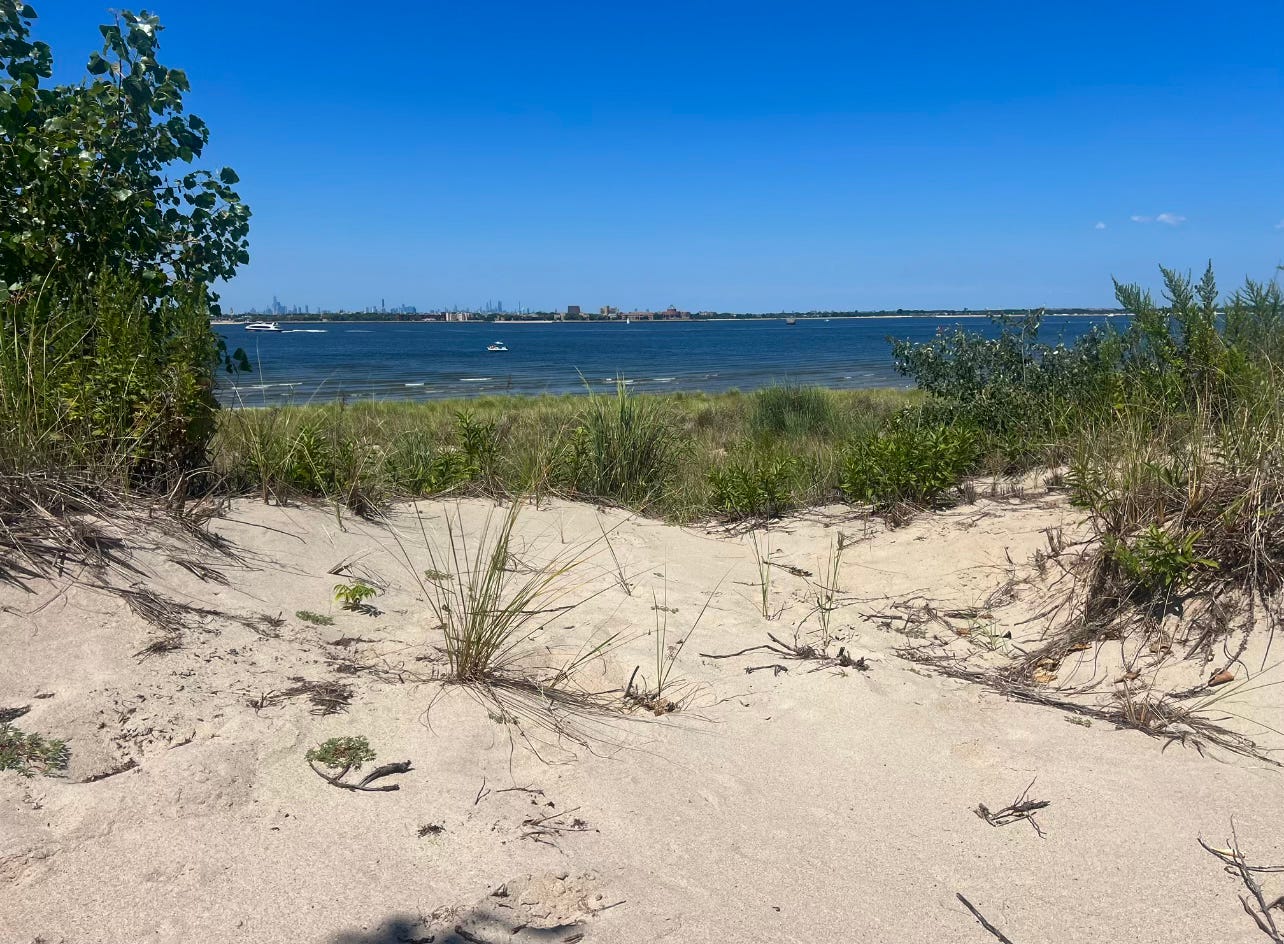
Though this young fledgling, born earlier this summer, will take no such flights. Their feathers will not molt into the sleek blacks, pure whites and subtle grays of a breeding plover. The fledgling’s flight ended just as soon as it started, on this hilltop dune on the edge of the channel of Jamaica Bay which separates Brooklyn and Queens.
Was the nearby adult the fledgling’s parent? Was the adult trying to protect their offspring from the Peregrine, and eventually met their own demise?
Questions for which we will never have the answers.
Peregrine and plovers united, these birds share the same physiology – ten primary wing feathers on each wing, the same biological needs, and identical hard-wired urges to survive. Both have been or are fragile birds on the brink. The Peregrine, whose protections began in 1970, pre-dating the Endangered Species Act itself, was once in precipitous decline due to organochlorine pesticides, specifically DDT, after World War II. Now recovered and delisted since 1999, Peregrine Falcons can be found on every continent except Antarctica. Known for their rocket-fast flights, they spell trouble for many migratory shorebirds, especially as the migrants stage before their southward migrations.
Curiously, there are fewer Peregrine breeding pairs in North America than Piping Plovers, yet plovers are listed as either threatened or endangered (depending on their location) and the falcons are not. This is largely to do with the future trajectories of each species. While one could argue that any North American bird is facing grave challenges in the future, it is the plover, not the Peregrine, that is most imperiled.
For no other reason than that the Piping Plover is a conservation reliant species. No delisting from the Endangered Species Act will come for the plover in my lifetime. It is only found in North America and it nests in places precisely where human-centered recreation, development, industrial agriculture and massive habitat alteration, persist.
“This is natural,” I said, as if trying to have a silent one-on-one negotiation with myself.
Unsuccessful at being pragmatic, the grief consumed me. Natural or not, there were two less plovers as part of the population.
I suddenly remembered the phone call I received in July 2023, when a juvenile falcon was fished out of Jamaica Bay, a few miles east of where the plovers’ wings were found. Having attempted to fly before their flight feathers were ready, the bird plunged one hundred feet downward into the bay. Peregrine Falcons have long nested on the Gil Hodges Memorial Bridge, which serves as the main connector for beachgoers traveling to the Rockaways on bus, bike and car.
A kayaker found the bird and contacted the United States Park Police, who then called me. Michelle Talich, one of our most dedicated plover protectors, jumped at the call to transport the bird, a known plover foe, to the Wild Bird Fund, the only wildlife rehabilitation center in New York City. The patient received fluids and some R&R before being transported to the Raptor Trust, a specialist clinic for the care of distressed hawks, owls and many other species, at the edges of the Great Swamp in New Jersey. A few weeks later, the bird was released back to the bridge and given a second chance.
Could this be the Peregrine we helped rescue?
Either way, while falcons are indeed a threat to plovers, both birds, the prey and the predator, share a common antagonist – Homo sapiens.
One day after receiving the news from Brady, I wanted to go to the beach myself. Armed with the GPS coordinates where the birds were found, I had more questions than answers. GPS can be useless out at Breezy Point too, given the spotty cellular service and the hot sun that makes your phone screen go dark.
Was it quick? Painful?
However painful this could have been – is the long slow death of an entire endangered species, leading to extinction, worse? The loss of your chicks and your habitat, punishing tides and storms caused by climate change, and the constant onslaught of humans disturbing your every waking move – this marks the days of many plovers in our city.
Lush goldenrod, sumac and beachgrass formed a carpet of green. National Park Service biologists in search of rare plants like Seabeach Amaranth and Seabeach Knotweed discovered this gruesome scene. This is the time of year that federally-threatened amaranth appears alongside invasive Mugwort and Autumn Olive.
A line of telephone poles punctuated the tree tops where the Peregrine has been seen perched over the course of the season. A plane soared overhead, the sound of its jet engines drowning any thoughts I was trying to muster. The quaking waxy leaves of an Eastern Cottonwood also did their best to compete.
I don’t know why I was there. I woke up that morning needing to travel there. Maybe it’s all the BBC crime shows that I watch, thinking that by going to the scene of the incident, that I would be able to piece together the steps of the crime, and solve it. But there was nothing to solve. There was no crime, instead, nameless victims whose lives upended in a very natural way.
It was still. Aside from the planes descending on their approach into JFK Airport, which crossed the sky at an even six to eight minute clip, I could make out each individual sound – the clanging bell of the red buoy in the channel, the chirps of red House Finches, and the call of a male Northern Cardinal from the olive tree behind me. A bright red kayak pierced the water, running parallel with the shore.
Red can symbolize danger and the violence of death, but also transition and mourning. There are no coincidences I told myself.
I dropped down, and sat under the shade of the cottonwood. Dunegrass brushed against my face as I watched a family come ashore from their boat below. They aren’t supposed to moor and recreate on the beach, but having to be a killjoy and explain the National Park Service’s rules was not on my mind that day.
I heard the faint call of a Killdeer, who was later joined by a Red-eyed Vireo, who would be off on their fall journey soon. I sat for a few minutes, soon realizing that this was the first time I had sat down on the sand this season.
I looked around. I thought that I was able to make out the footprints of plovers, but it could have been any number of passerines which use this stretch of beach as a refuge. I rose to my feet and turned towards the water to leave.
As I looked back one more time, my eyes welled up with tears. It has been a tumultuous and emotional fifth season and it was rapidly coming to an end.
I am not sure what I was expecting, but as I walked away, a peace rush over me, a kind of private closure that I felt privileged to have been given. Closure because we often don’t know the outcomes of these birds. These two plovers died right in the spot where I was standing. This place was now sacred. The plovers will always be connected to this stretch of sand, and now, to me.
Great writing, Chris! Thanks for sharing.
I’ve seen peregrines hunting on beaches quite often, more down at the other side of the Rockaway peninsula and on a few beaches on Long Island. I’ve often wondered if it’s behavior that predates anthropogenic changes or something they’re pushed into because of a lack of suitable forage habitat elsewhere. Old guides and books refer to them as “duck hawks” which feels like one piece of the puzzle there. I imagine it’s often difficult, in your work, to develop individual connections to those plovers
thanks for sharing (and coming to the BMI/Orion talk last night). I know all these places and birds you're writing of, and it's always a complicated amalgam of feeling, witnessing the wild world unfold in all its necessary violence. Life taking life to support life. Mercifully, peregrine kills are often quick. Now, you hold on to the memory, and the place changes. And you.