
Kogia
The story of the last moments of a Pygmy Sperm Whale

Volunteer Jordan Horowitz watched as the sleek terns circled above, taking turns as they dove into the shallow sea water, picking off tiny fish like sand lance and shiners. Sanderlings scurried at the edge of the bubbling waves, while a crowd was gathering further down the beach.
Just five days prior, the final Piping Plover chick in New York City hatched here. But this crowd was not forming to celebrate this tiny, new New Yorker.
Jordan first saw a dorsal fin, of what he was convinced was a struggling dolphin. He walked closer as men pulled the tale of the mammal, apparently trying to return it to sea.
“That’s no dolphin, but some sort of whale,” a jogger quipped while shuffling by without stopping.
Park police arrived within twenty minutes and whisked people away. The whale writhing in agony, at the edge of the ocean, but far from its deep sea home. I texted my friend Chris St. Lawrence, who is the communications director for Gotham Whale, a local non profit helping to educate New Yorkers about the uptick of whales now spotted off our city’s coast.
“This is a sad, but very, very, very, very rare find,” Chris wrote back in less than a minute, with four verys. “Kogia are some of the most elusive cetaceans in the world.”
Kogia breviceps, or Pygmy Sperm Whales are a deep-sea species, living at shelf break, more than 70 miles offshore. Jordan’s misidentification was fair given that Kogia are just nine to twelve feet in length, not much bigger than the far more common dolphin. Something was likely already very wrong with this whale to be so close to shore, which was likely the reason for the stranding. Threats facing Kogia range from entanglements with commercial fishing gear like gillnets and trap pots, to vessel strikes and ocean noise, particularly in areas with high marine traffic, like the Atlantic Bight.
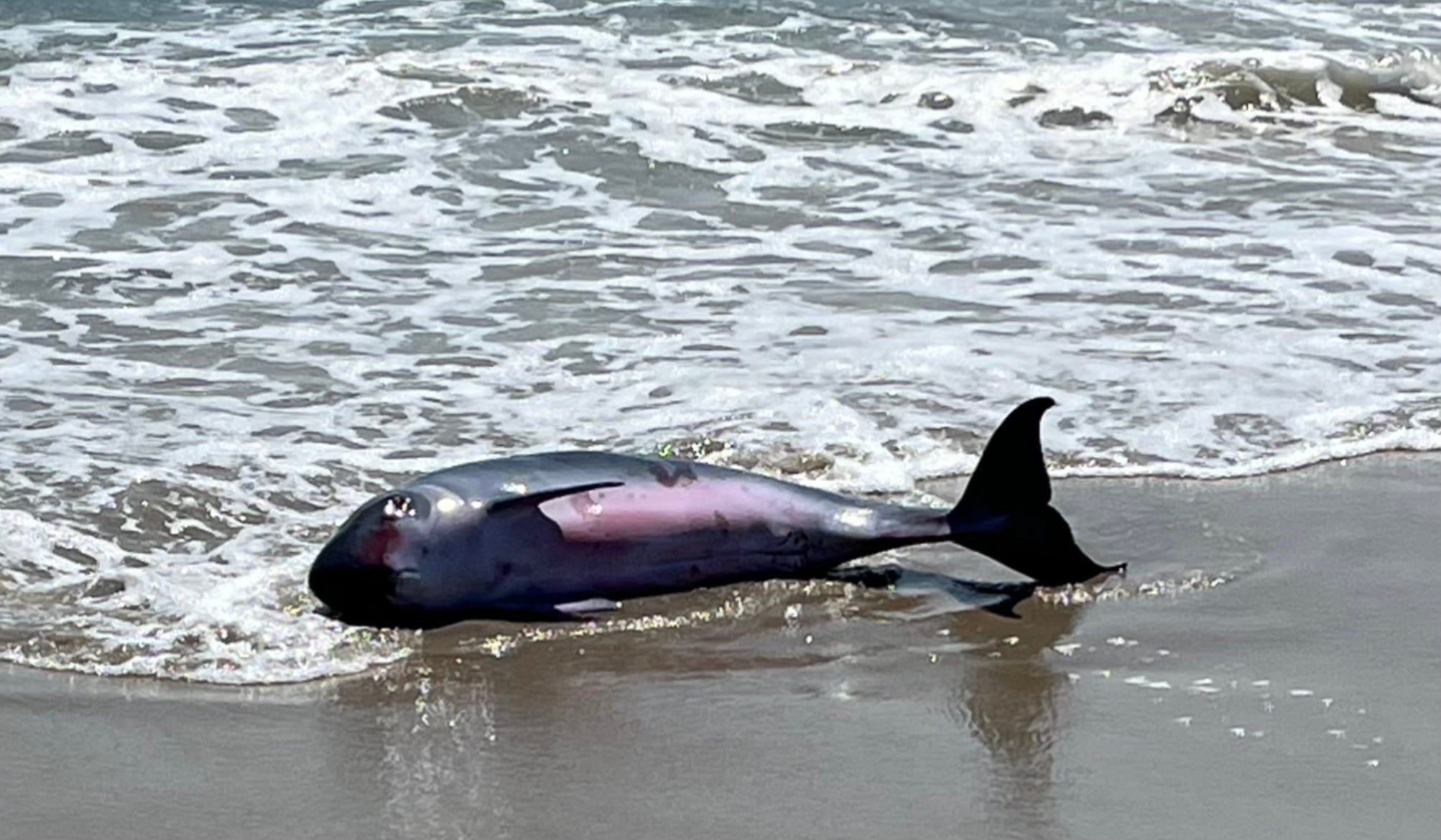
What appeared to be blood spilled into the water, turning the tide crimson. This was most likely reddish-brown ink that whales release when they feel threatened, to cloud the water to get away from predators. But no flurry of ink would help this whale to safety. He was in his final moments.
A second volunteer, Amanda Chambers, arrived for her shift as a small crowd formed.
I rang my counterpart at the park service, Brady Simmons. She reported that calls were made to the marine rescue service out in Riverhead, which is easily a three-hour drive into the city on a late July afternoon.
I knew at this moment that this whale wasn’t long for this earth.
Not one to easily entrust others with matters like this, I also called the rescue group’s answering service. Help was indeed on the way, but a couple hours out as I had suspected. There is no whale rescue closer to New York City, which will almost certainly serve as a mounting problem as we see more strandings of injured marine mammals.
Instructions were given to keep the blow hole out of the water. Cetaceans are not built to support their own body weight so stranding causes major internal damage.
A few minutes before the rescue group finally arrived, the tide took the tiny whale, as it appeared to swim off to freedom. Though this homecoming was cut short, as the whale could only swim about 25 yards to the end of the jetty.
The whale returned to shore within a few minutes. Amanda noticed more scrapes from the jetty rocks, freshly carved into the whale’s beautiful, slick blue gray skin. The whale landed further to the east, directly in front of where the one chick hatched, and another unattended egg remained.
Six people from the rescue group and the state environmental conservation agency, together with assistance and permission from the National Park Service, entered the closed area for the Piping Plover nest, and waded into the surf, carrying a large stretcher. They silently rolled the animal onto the fabric and carted the whale from the sea, a mechanized process which they had clearly done before. The whale was carted from the sea, the only home they have ever known, for a final time. The whale was then humanely euthanized.
I called Jordan. His voice was cramped, he could barely get out the words clearly when we spoke. He cleared his voice, “I got back to the car after my shift and I was just overcome. I cried.”
“I am just so grateful to be a part of this organization.”
Choked up, my voice quivered.
“Well, you can never leave. La Famigilia,” I said, in a joking attempt at an organized crime reference.
We both laughed, a brief moment of needed levity.
Jordan added, “As the whale came back onto the beach one more time, it appeared to give its life to the young plover.”
I agreed.