
Claude and the Plovers
The story of an albino alligator and San Francisco's endangered species, the Snowy Plover

A new book in his honor dropped. A sit-down dinner prepared by a Top Chef winner. “The Big 3-0,” a limited edition beer. Plushies, pins and stickers with his image filled gift shops. His birthday cake, made of fish and ice, was presented on the big day. Thousands attended month-long celebrations across the city in September 2025. Claude the alligator, one of the most famous San Franciscans, was turning 30.
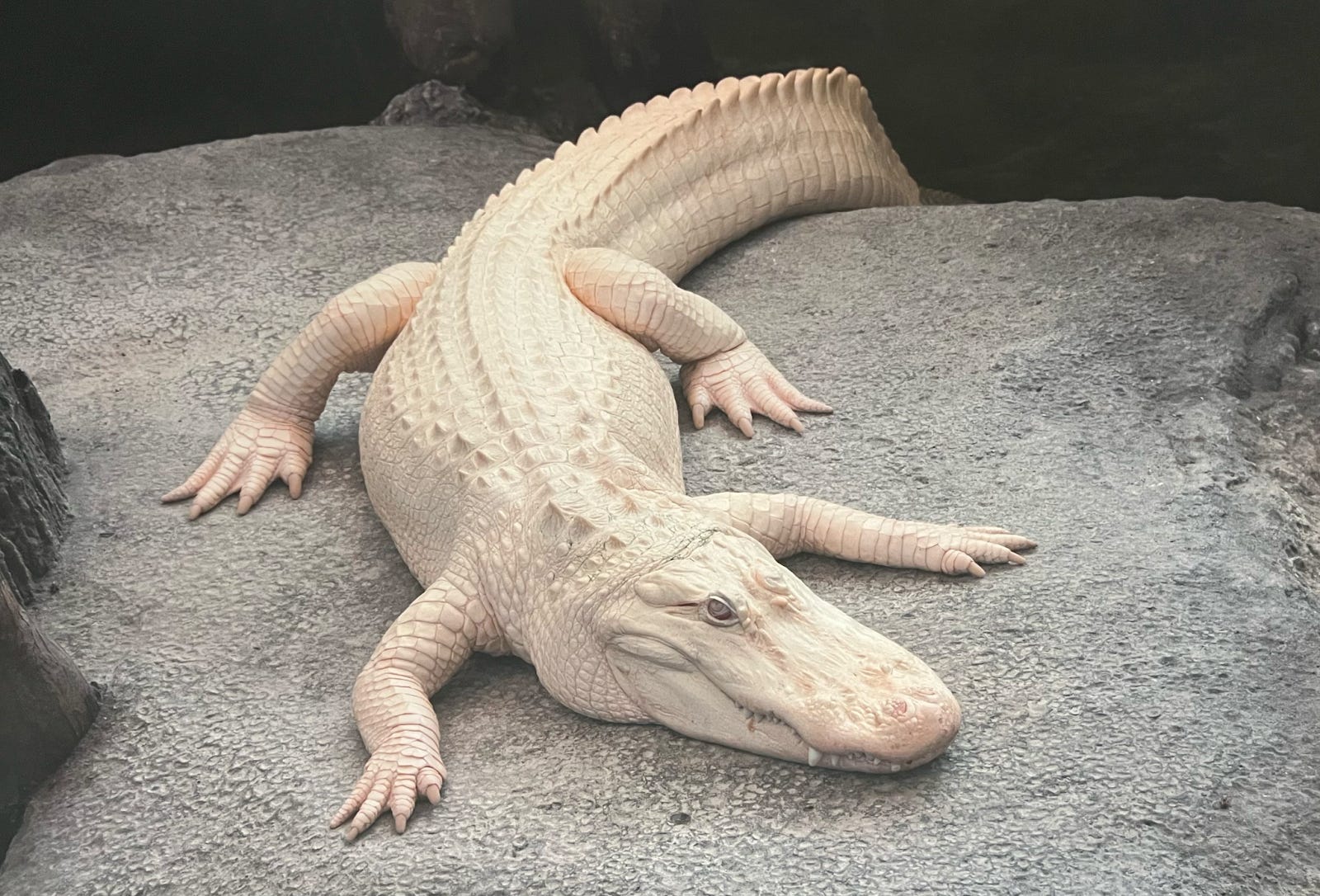
Hatched in Louisiana, Claude arrived at the California Academy of Sciences in 2008, after a stint at a zoo in St. Augustine, Florida. And while alligators in captivity can live up to 70 years, alligators with albinism like Claude rarely survive long. Considered a rarity, just 100 to 200 albino alligators are believed to live in the world. Given their poor eyesight and sensitivity to the sun, survival is precarious if not impossible.
I knew if I landed in San Francisco by 2 pm, I could get to the hotel in an Uber, drop off my bag, and then hop on the Muni light rail to Ocean Beach, arriving ahead of the sunset, just before 5 pm.
The sun cut through the Sutro Tower to the east, atop the hills above the Castro. I should have enough time to find them. There at the beach, I climbed to the crest of the dunes covered in ice plants bursting with magenta blossoms. I needed to decide, go left or go right? I looked through the viewfinder of my long-lens camera, and then decided left. Many small birds, and less dogs and people, we had a match. Flocks of Sanderlings formed as the waves dissipated on the shore, with a ferocity I didn’t recognize from my far more familiar Atlantic. The December sun hovered above the horizon, out far in the Pacific, a ripe California orange still illuminating the warmed sand. The temperature was dropping, but I was in a t-shirt and light coat.
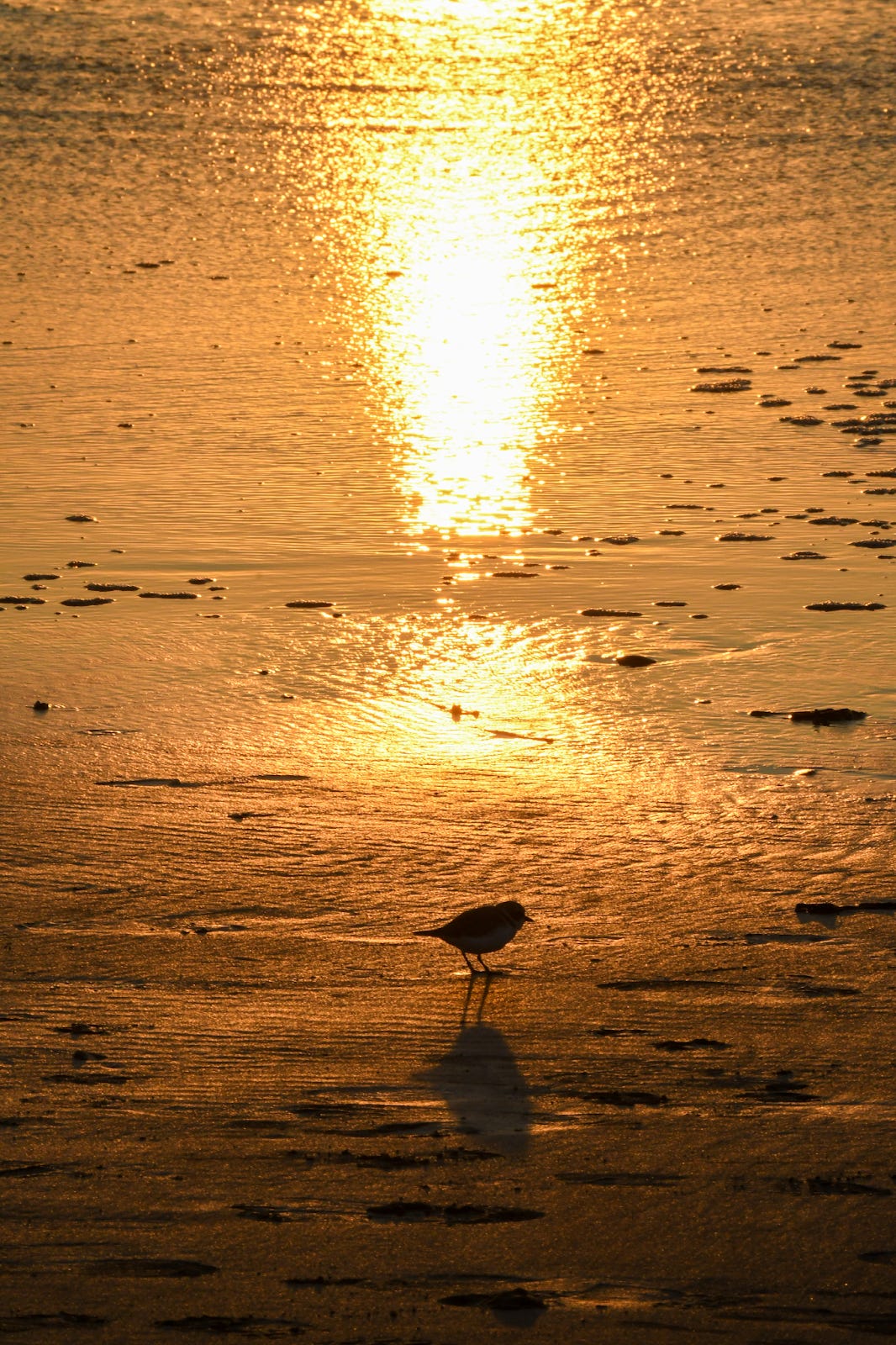
For some reason, I checked eBird after I arrived, a rookie move. One birder spotted them at their usual roosting location, which was in the opposite direction, 1.7 miles north. It was 4:17. I had half an hour if I was lucky. I hoofed it and just as the sun seemed to be a few inches above the ocean, A single Western Snowy Plover ran along the ripples of the water, where the dry sand met the wet. And then another just behind the first one. Run and stop, run and stop, just like the Piping Plover. Seeing the cousin to our plovers back east always gives me a rush. It’s not lost on me that alligators like Claude and plovers are closer relatives than us humans are to birds, descendants of dinosaurs, both hatching from eggs.
Where have you been, little one, and where are you going?
I lowered my camera from my face, and held the moment to take in the bird that I had come here to see. As the sun set, I crossed the beach towards the stairway up to the street. Plovers reluctantly rose like popcorn kernels from a hot pan, one by one, then walked away from me.
I stopped and tried to assess the best way out without disturbing any more of them. I decided to sit down for another minute or two. Slowly they all came back and continued their evening roost. The beach was soon dark except for the rising moon illuminating the sky, set to be full in a few days. People disappeared into the night and the sounds of dogs subsided.
Tu-wheet, tu-wheet.
The sweet calls of the Snowies clearly rose above the sounds of the crashing waves. Without provocation, at least noticed by me, they flew off again in one giant flock departing at once. I walked back towards the water. Plovers foraging, undisturbed, with the threat of beach walkers, joggers and dogs now gone. So much of their lives is spent camouflaged, hiding, trying not to be noticed. Such a stark contrast from the goal of most of us being to be noticed. I think about the communications work I have done for clients over the course of my career. Helping executives stand out, to tell their companies’ stories and be memorable. It’s a survival tactic; if you want to grow a career, get more funding, sales, and customers, people must see you.
Sand dunes once spread from the beach where I stood and crossed much of the western portions of the city. As habitat for the plovers has diminished, so has awareness for them. While Snowy Plovers don’t nest in the city – choosing breeding areas in the South Bay and to the north at Point Reyes – they do spend upwards of nine months on San Francisco’s busy beaches. During my visit, I saw no volunteers, rangers, or fences cordoning off roosting habitat. Instead, one burned and twisted sign. The melted paint mirrored my rising feelings, reminding me of the anger that overtook me when I first saw the off-leash dogs at Fort Tilden in April 2020.
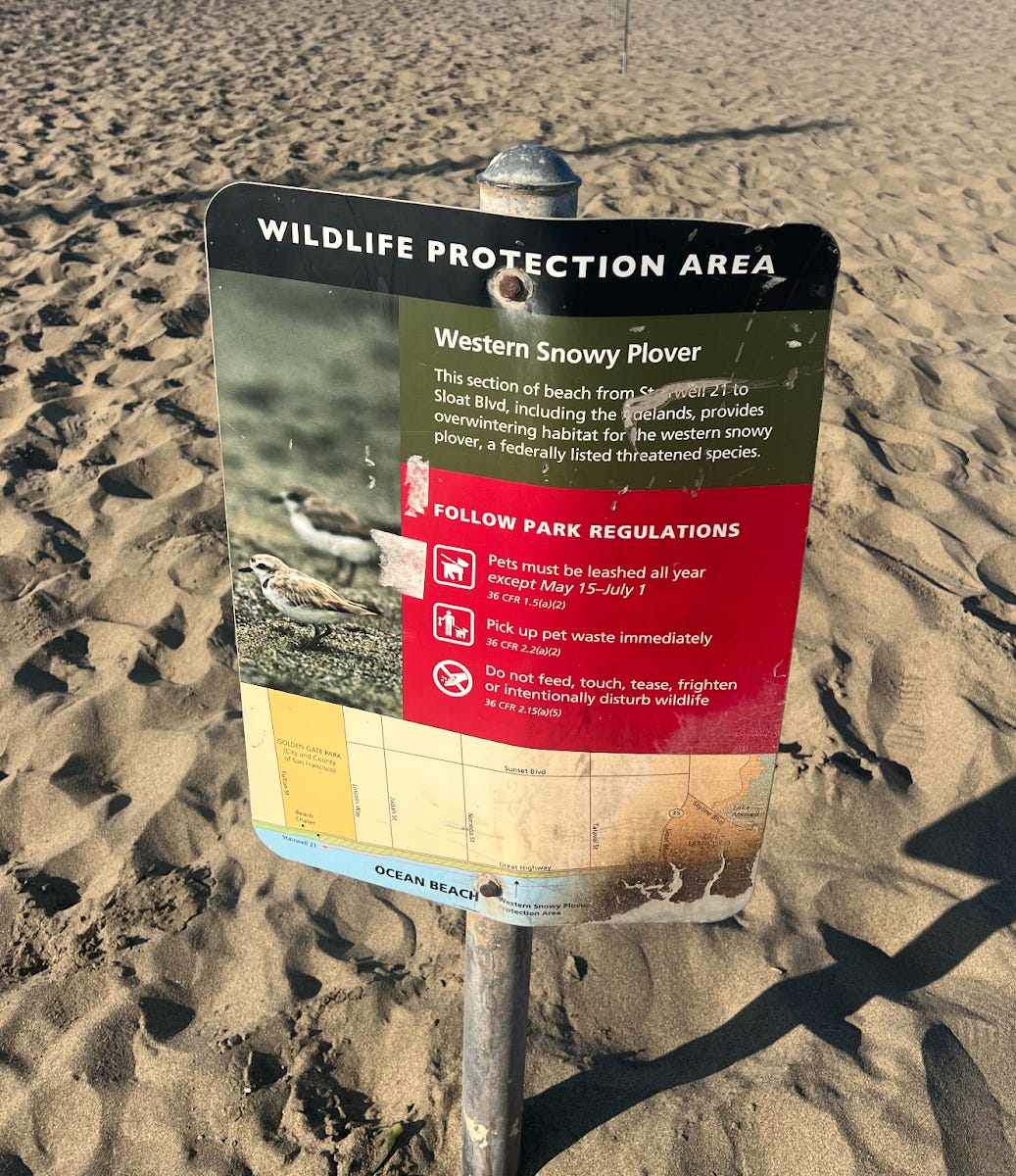
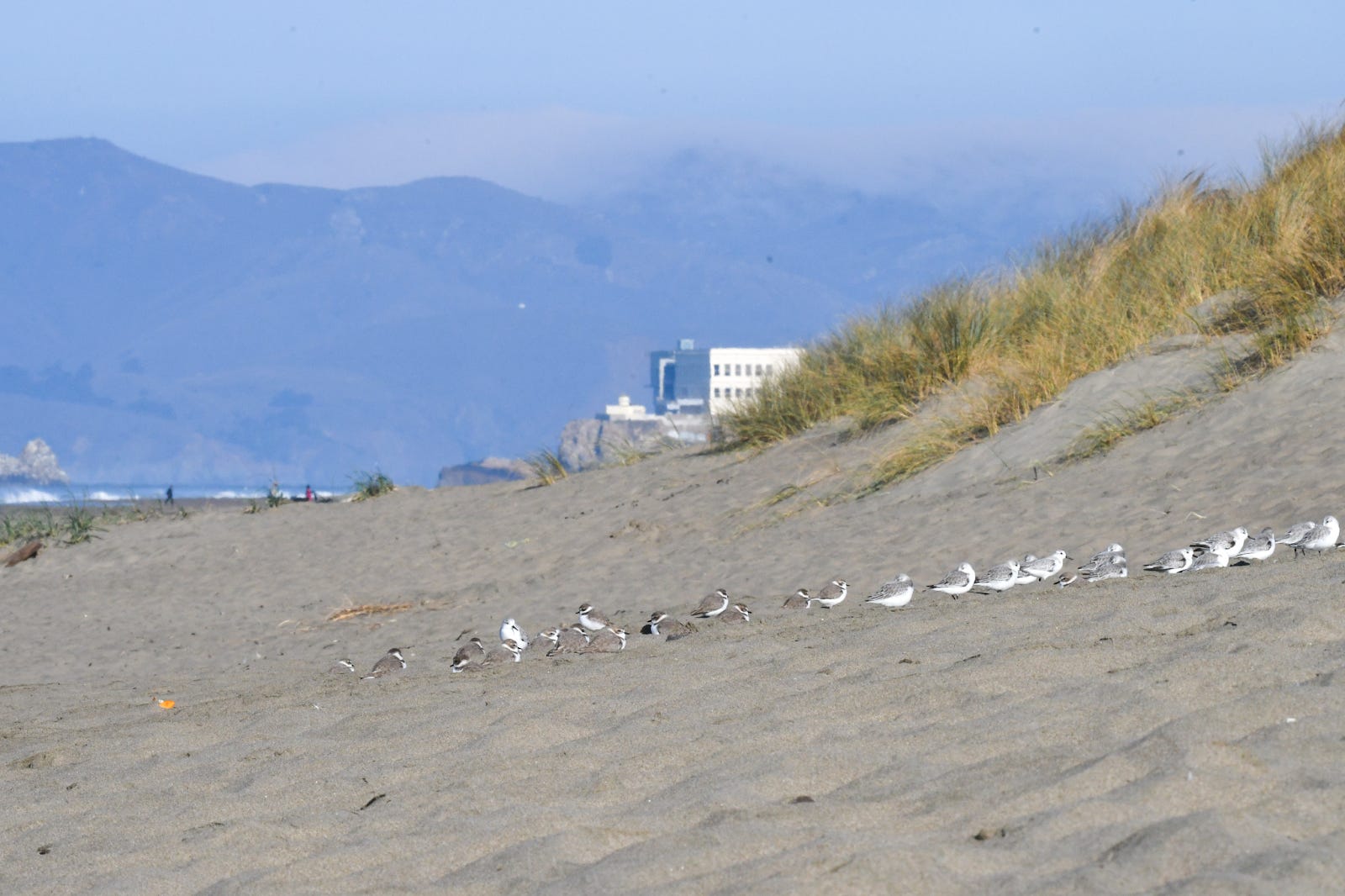
We are more vigilant about protecting Snowy and Piping Plovers during their nesting seasons, yet when it comes to the winter months, plovers are left to fend for themselves, on their own. We can and should do better than a simple “good luck” at the end of each breeding season.
Protection is written into federal law, the Endangered Species Act of 1973, and the recovery plan for the Pacific population dictates that federal agencies and lands take the leading role in monitoring and management efforts to assure the survival and the recovery of the species. The Western Snowy Plover was first listed in 1993, mandating the recovery and protection of the birds on both their breeding and wintering locations. This includes Ocean Beach, part of the Golden Gate National Recreation Area, a national park. Founded in 1972, Golden Gate is the sister park to Gateway, where we do our work with the NYC Plover Project.
The day after my first visit that week to the beach, the news broke that Claude had died. His necropsy revealed liver cancer. I was intending to go to see him on my trip. In April 2025, when in San Francisco for climate week, my partner Sam joined me. He went to an event at the Academy, telling me how he saw the albino alligator and a Giant Pacific Octopus with a plastic toy.
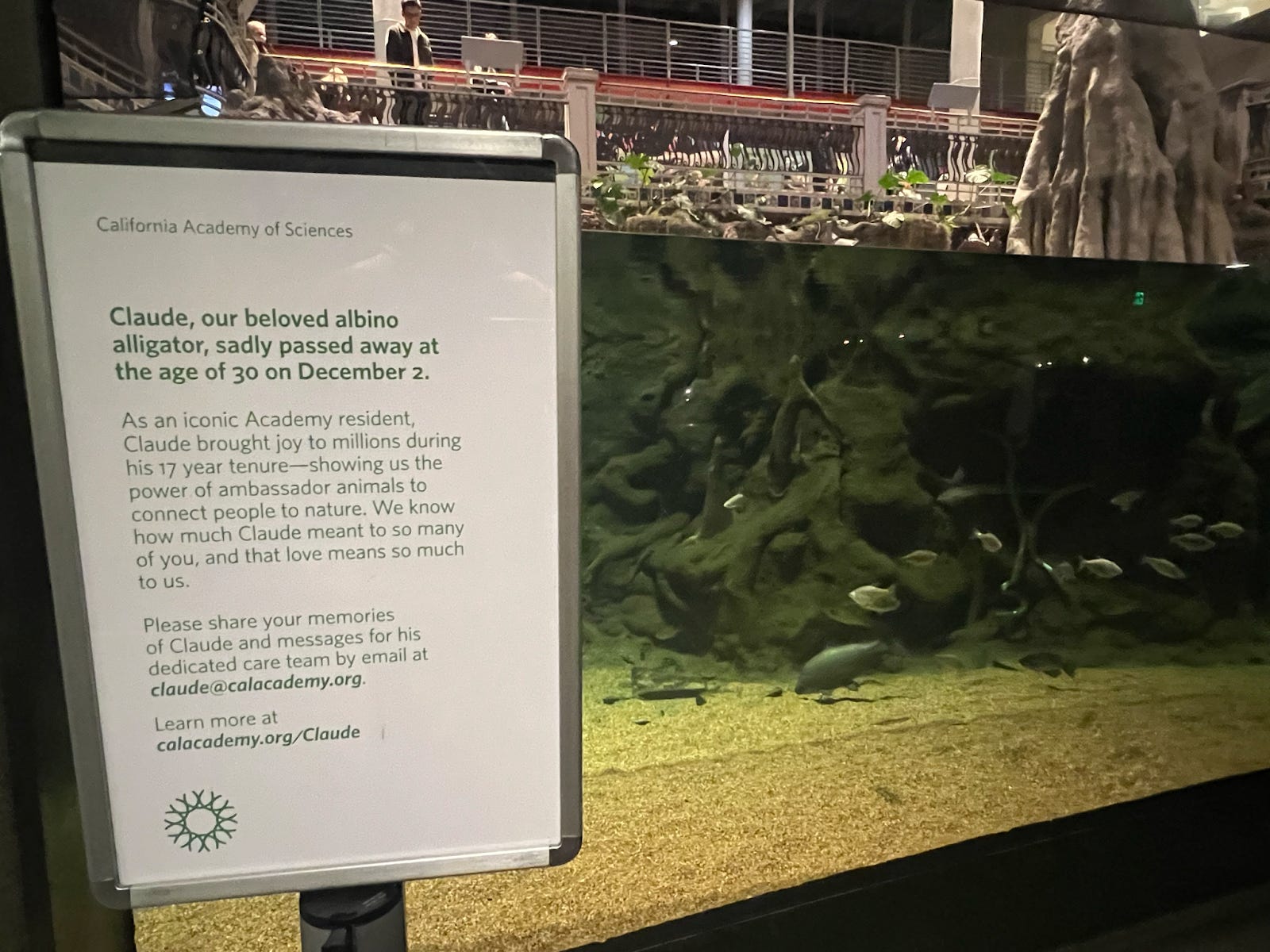
News of Claude’s death led on the evening news. Grief and condolences poured in. Speaker Emerita Nancy Pelosi wrote on X, “San Francisco is heartbroken by the loss of Claude—our city’s distinguished albino alligator who was taken from us in his prime at just 30. Claude was a cold-blooded icon of Cal Academy who connected millions to the wonders of science. Our city won’t be the same without him!”
Two days later, the museum was holding one of their late night events called NightLife. My meetings finished for the day, and I felt drawn to go to pay my respects. Claude was gone and the octopus Sam mentioned was not viewable in the dark tank.
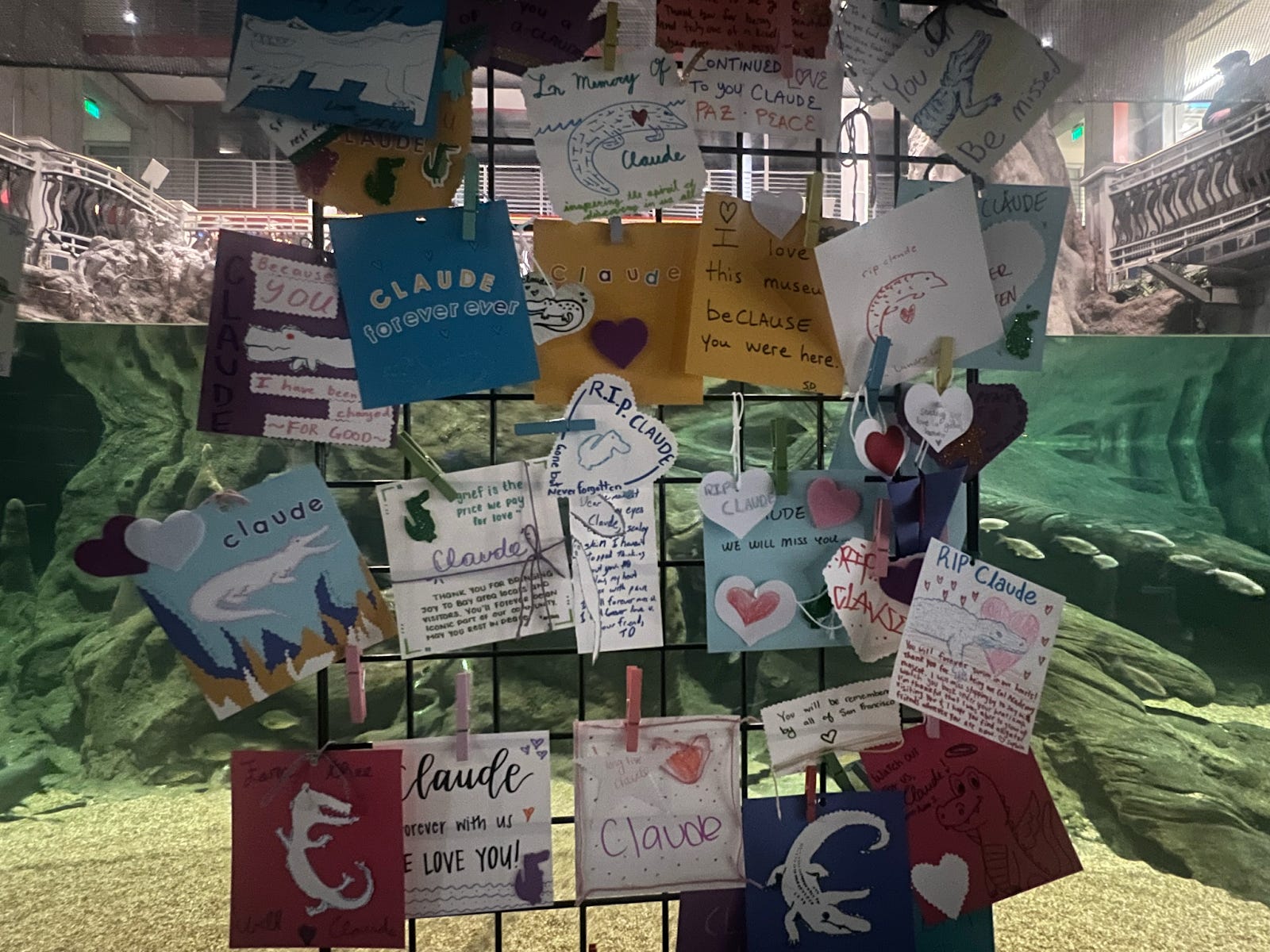
But this was no wake, but rather a celebration of life. A mix of “All I want for Christmas” played on the loud speaker as I entered the cavernous space, amongst festive merrymakers in lines for cocktails. A hub of activity had formed around Claude’s swamp, the large tank and constructed habitat where he spent his days. Long tables of people overflowed with construction paper, scissors, glue sticks, and markers; creating cards and letters to Claude. “Santa Claude” was still on despite the untimely death of the celebrity resident.
Golden Shiners, Spotted Gar and Smallmouth Buffalo – fish more common in a Louisiana bayou than the City by the Bay – swam as if aimlessly, their eyes darting towards me and the other onlookers. Three large Alligator Snapping Turtles clung to the sides of the rocks, also rescues, seized by wildlife officers at the airport decades ago, saving them from becoming soup in a local restaurant. A young docent I spoke with shared that there have been tussles amongst the reptiles, but largely coexistence, with the turtles often swimming just below Claude unbeknownst to him.
While I am sure their lives will continue without want, the turtles and fish will escape the spotlight that came with living together with Claude. The un-named supporting cast alongside the leading player, are much like the plovers out at Ocean Beach, largely out of the public eye, and do not command the attention that Claude once did.
In late October, in the Mission District, a Waymo struck a cat named KitKat, affectionately known as the “Mayor of 16th Street.” With a neighborhood market as home base, word has it that KitKat used to frequent a dive bar down the block, according to a New York Times story that ran after his death. In early December, another wayward Waymo struck a dog named Leo in the Western Addition neighborhood.
And while uproar ensued, a city already uneasy about big brother/big tech doesn’t seem to mind how another endangered San Franciscan is treated. Call it the power of the named animal or our love for cats and dogs, but the Western Snowy Plover, numbering fewer than 2,000, scurries to survive amongst unleashed dogs, e-bikes, joggers, and human indifference.
The celebration continued. I extended my condolences to another staff member looking forlorn as she peered down into Claude’s swamp. I asked about the fish and turtles, suddenly without their neighbor. She confirmed that many others have asked the same thing. She didn’t know for sure, which is fair. “He was more than an exhibit,” she added. That became immediately clear to me. Newspaper reports wrote that Claude’s every movement, although infrequent, prompted oohs and ahhs. Thousands gathered this past week for Claude’s official memorial and a street will be renamed for him.
Claude was a draw for sure. Problematic or not to house wild animals in captivity, he brought visitors who flocked by the hundreds of thousands. But Cal Academy’s biggest draw was now gone. And while they marvelled at the bone white protagonist, and spent money on alligator-themed merch, maybe they caught a glance of lesser known species and learned more about our imperiled marine environments. I would like to think that yes.
Back at the party, we queued up to watch a new show at the planetarium called ‘Spark: The Universe in Us,’ narrated by actor Diego Luna. It was an hour in length and was filled with a tsunami of facts about the cosmos. I struggled to pay attention. I instead thought of the universe within an alligator, that everyone wished we could have seen instead that night.
The power of a story, the one about the alligator that wasn’t meant to survive. An example of his species that would’ve gotten rejected or cast out. Different, yet strong and resilient from his perceived weakness. I saw myself in that alligator as many of the queer folks I saw paying homage to him. Claude’s mourners had bright-colored hair, tattoos and face piercings. They came in wheelchairs, both young and old, all paying their respects for the wonderful life of an extraordinary reptile.
I thought of the word examplar, one of a group that shows what the whole is like, or someone of such unequaled perfection as to deserve imitation. Both of these definitions could apply to Claude. Over seventeen years, Claude brought joy to millions. I only wish I would have met him.
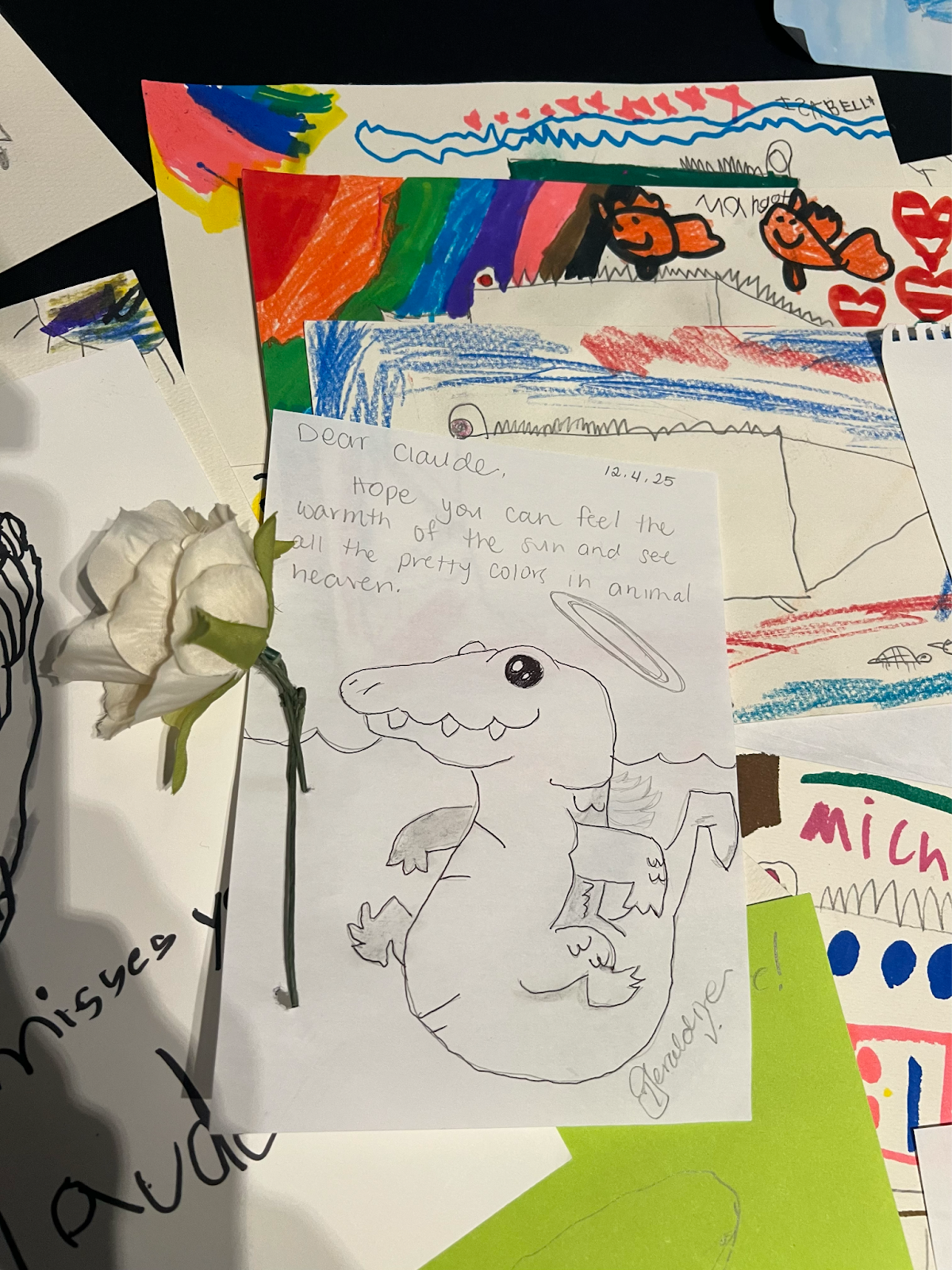
I looked at the cards before leaving. Geraldine wrote, “Hope you can feel the warmth of the sun and see all the pretty colors in animal heaven.” T.O. added, “From the moment I laid eyes on your scaly skin, I haven’t stopped thinking about you. How my heart aches with pain. I will forever miss you. I will forever love you.” Another card showed Claude swimming, with “In memory of Claude, inspiring the spirit of discovery in us all,” written in green marker.
The next morning, I returned to Ocean Beach. As I was seated on the sand to take photos of the plovers from a distance, an off-leash dog barreled towards me and in the direction of the flock of roosting plovers near where I was sitting.
“Hey, can you leash your dog,” I said to the dog’s owner.
“Can you fuck off?” he replied. “Why don’t you stick that lens up your ass,” he added, referring to my camera.
It was hard not to match that level of aggression and it’d been a long week. I returned a few pleasantries, but felt that I was more measured in my response. The off-leash dog man left, but not without hurling additional obscenities my way.
An extreme reaction from an unbalanced person, but symptomatic of a broader, bigger problem – of a fragile species left to fend for itself with neither the protection, nor enforcement of federal law on federal land, And, this was the very problem that I sought to solve at our national park back in New York. I thought about the episode and tried to examine my part in it. I definitely didn’t employ the conflict de-escalation model that we use to train our plover project volunteers. As I went back and forth in my mind, I realized my true transgression, for off-leash dog man at least, was questioning someone about their off-leash dog.
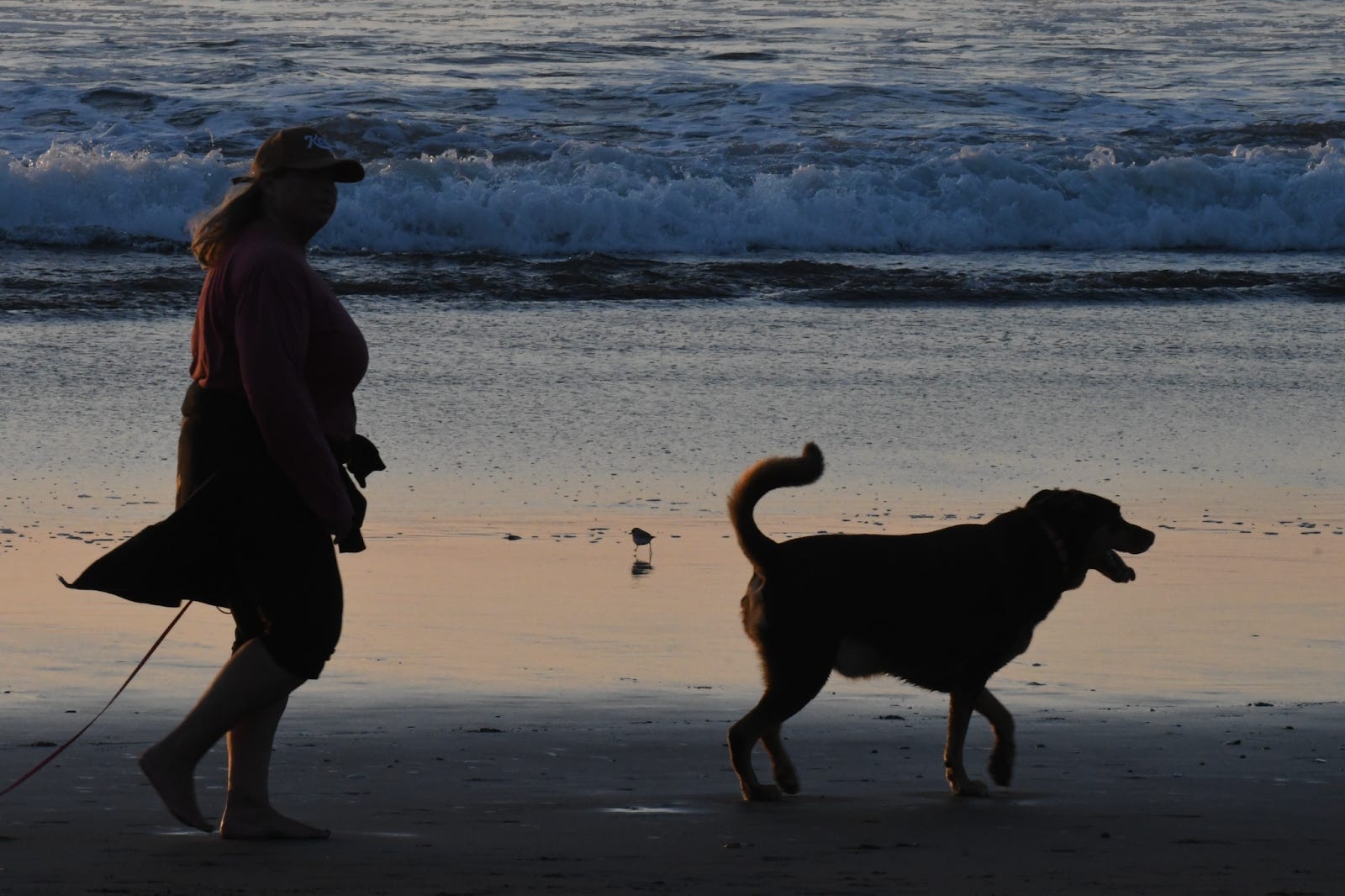
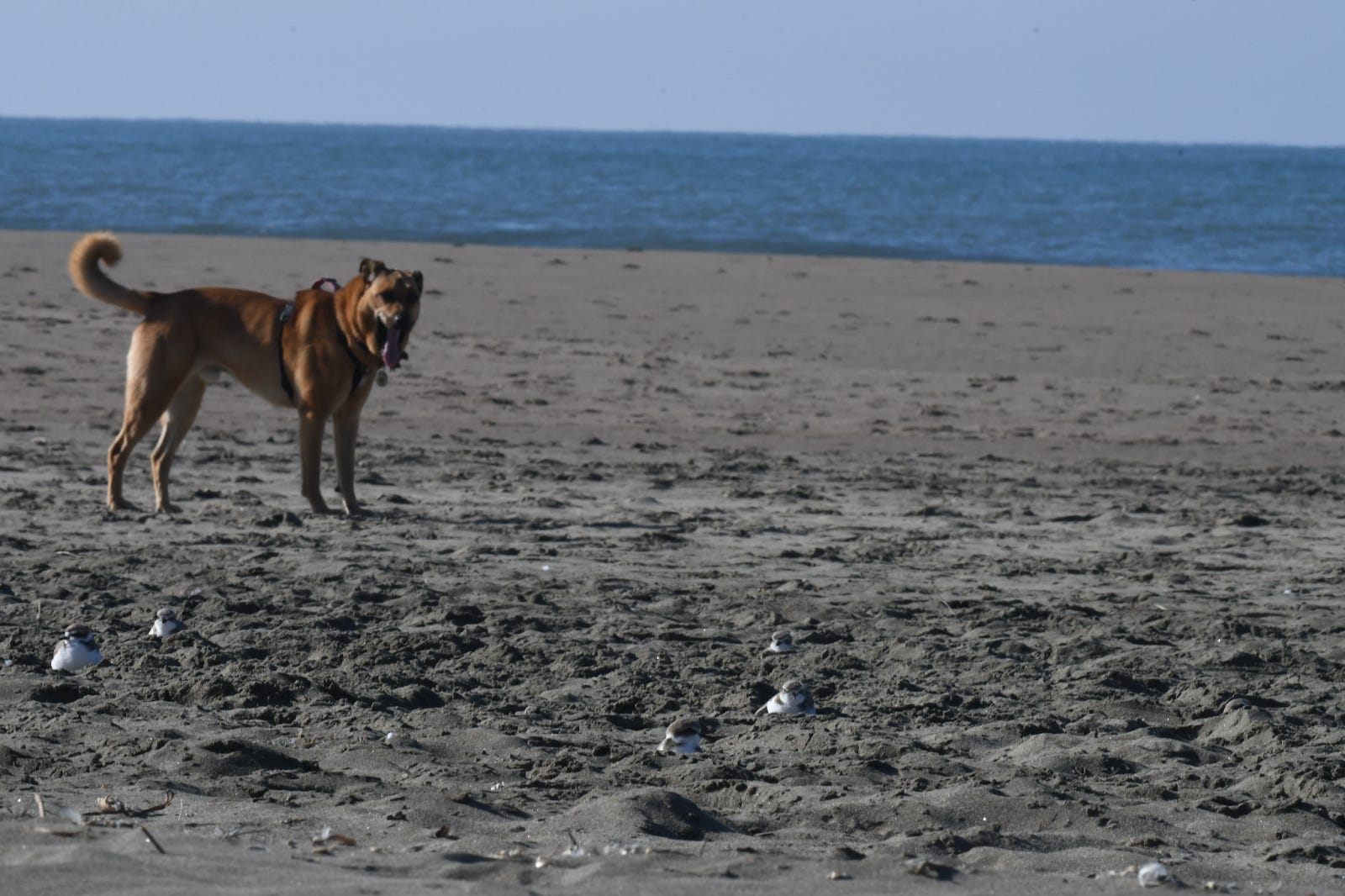
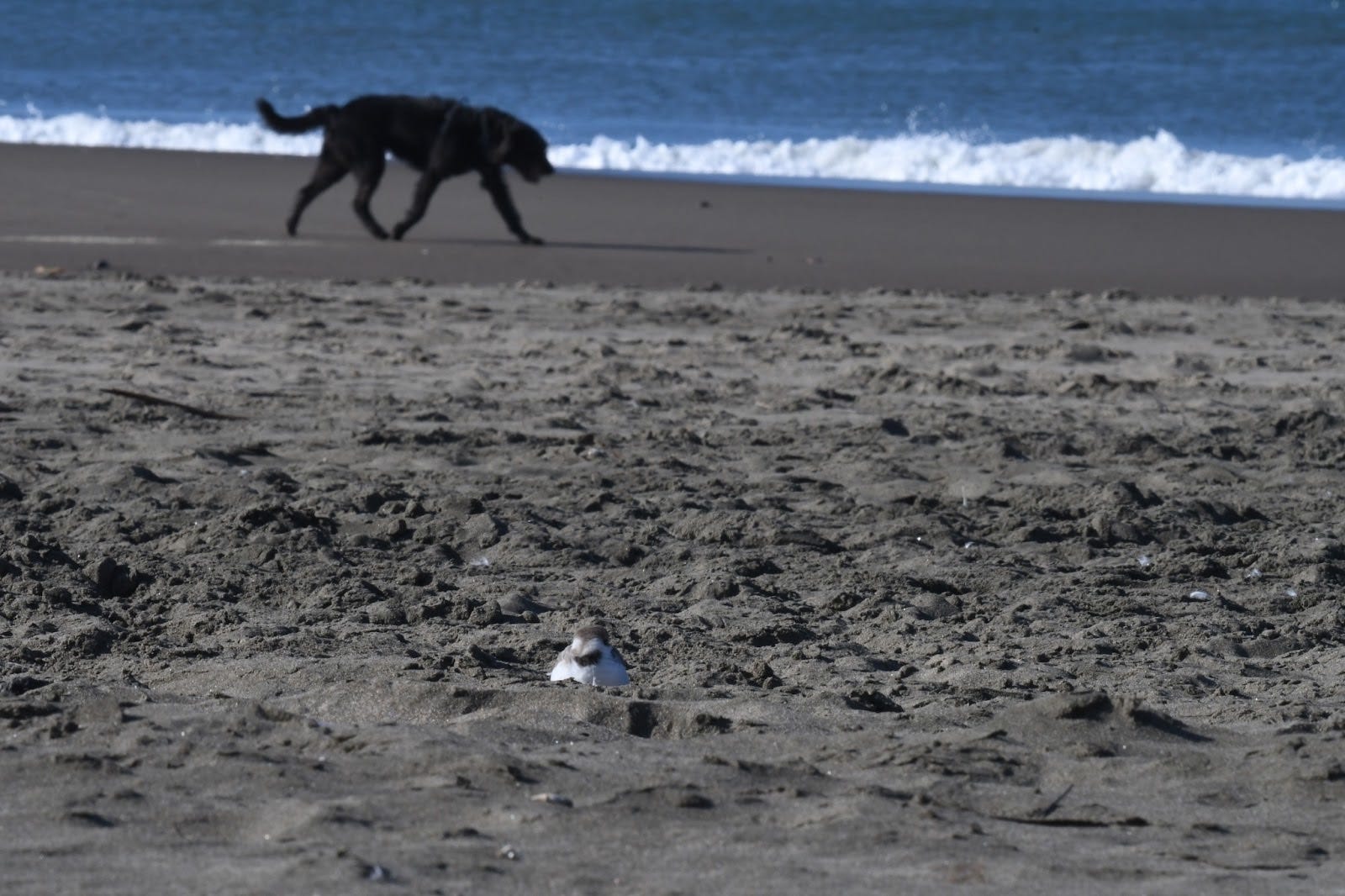
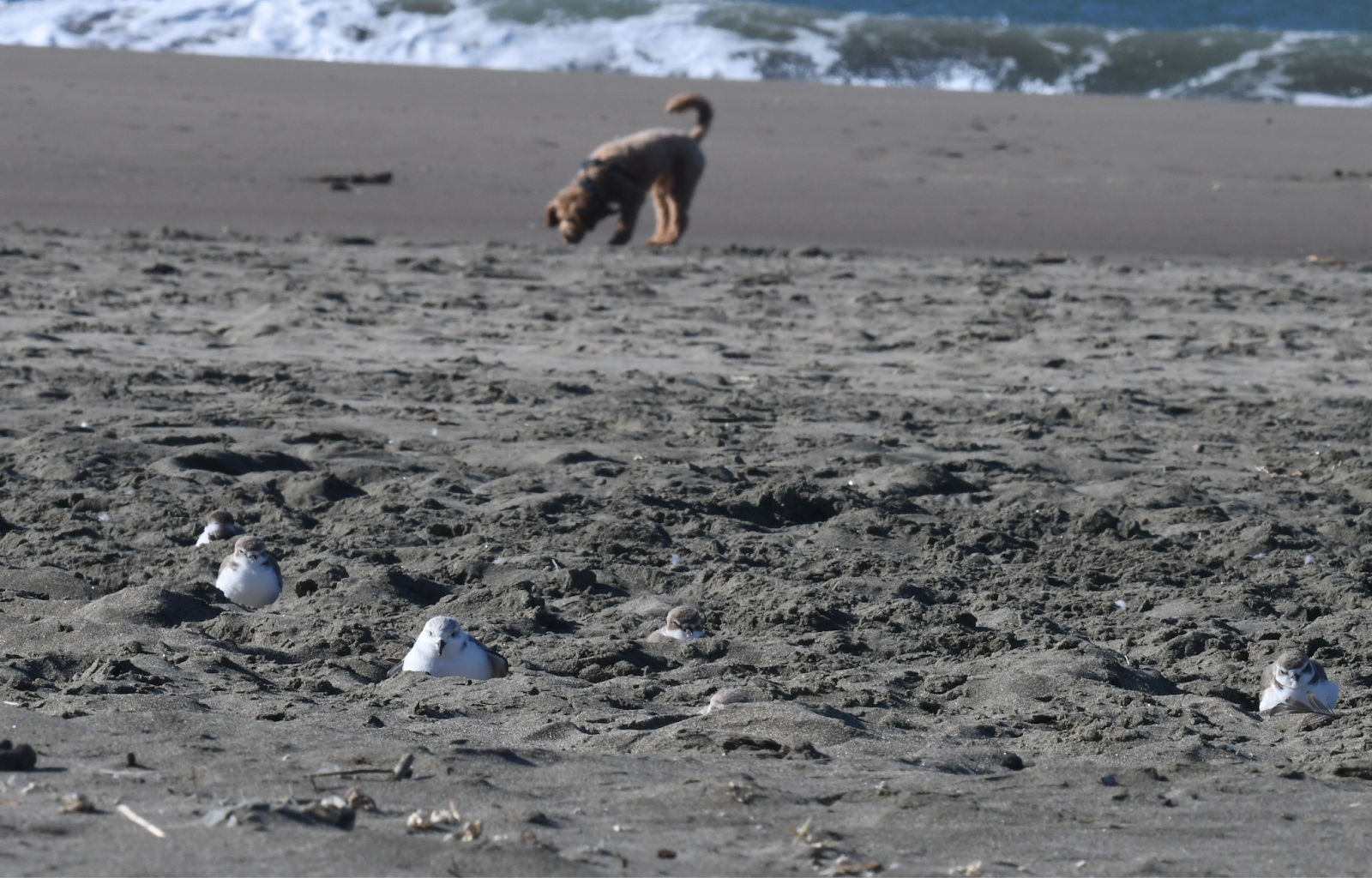
Author Ben Goldfarb captured the problem in a 2023 article for Hakai. “Ultimately, it’s hard not to conclude that the furor over dogs is a red herring—for the real problem isn’t our mutts, but our cognitive dissonance. Just as we forgive the foibles of our human relatives, we ignore the casual harm wrought by our four-legged children. Perhaps because our dogs’ behaviors are a direct reflection of us, we harbor the delusion that they’re under our control; We rationalize their misdeeds, overrate their training, prioritize their pleasure over other beings’ right to exist. Love is not only blind, it’s blinding.”
I got up to leave the beach as I had a flight to catch back to New York. As I brushed the sand off my jeans, and the guy who accosted me in equal measure, neither the first nor the last time someone will unleash their wrath when I speak up for birds.
I really didn’t want to leave. I tried to time my departure when I knew no more dogs would be charging towards the plovers. I often do this back in Rockaway. It’s a combination of “not on my watch,” deep concern, and being a control freak. But I am not in control. We aren’t their caretakers or keepers. But, unlike hatchling Claude back in the bayou, they aren’t safe.
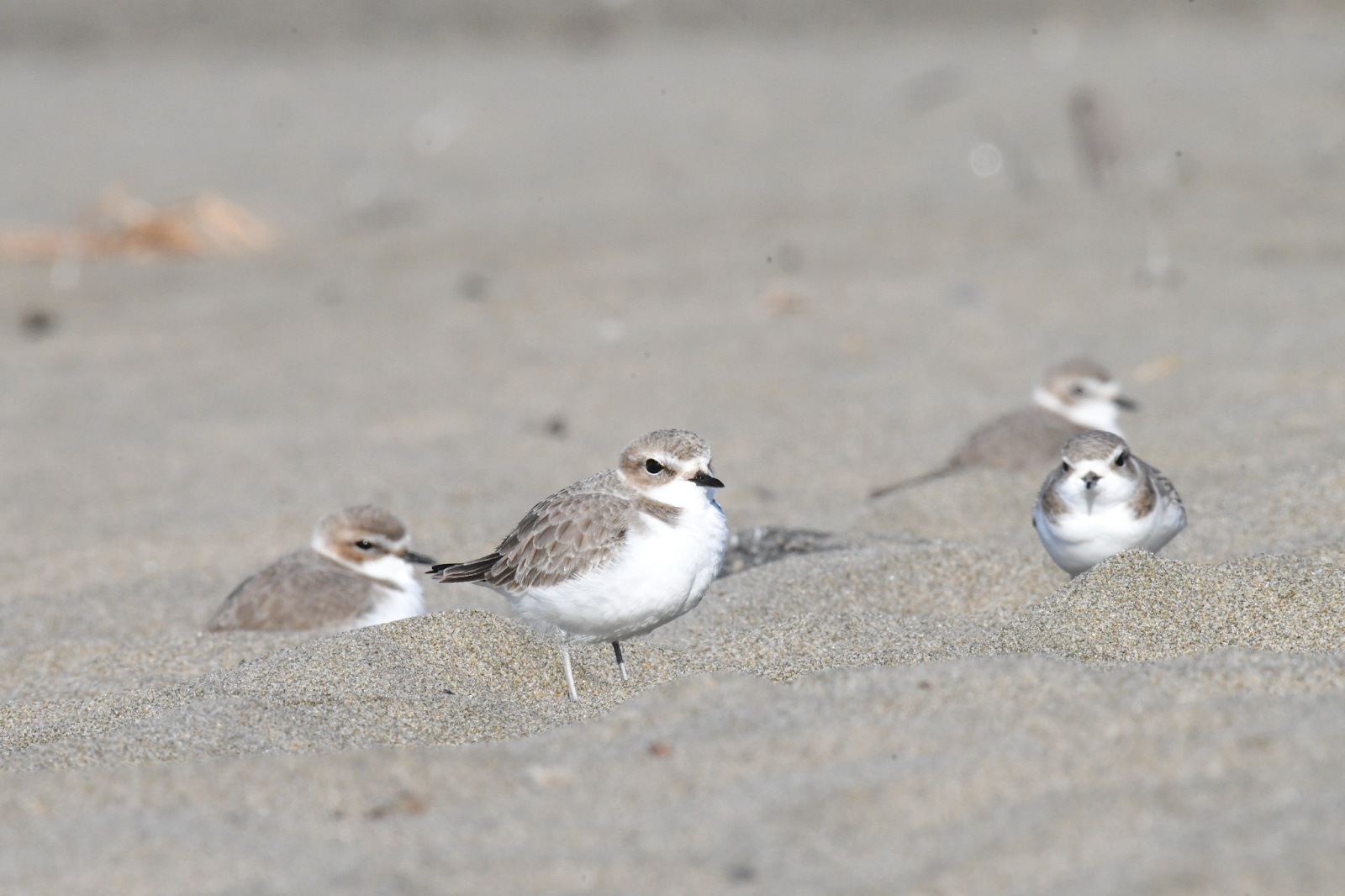
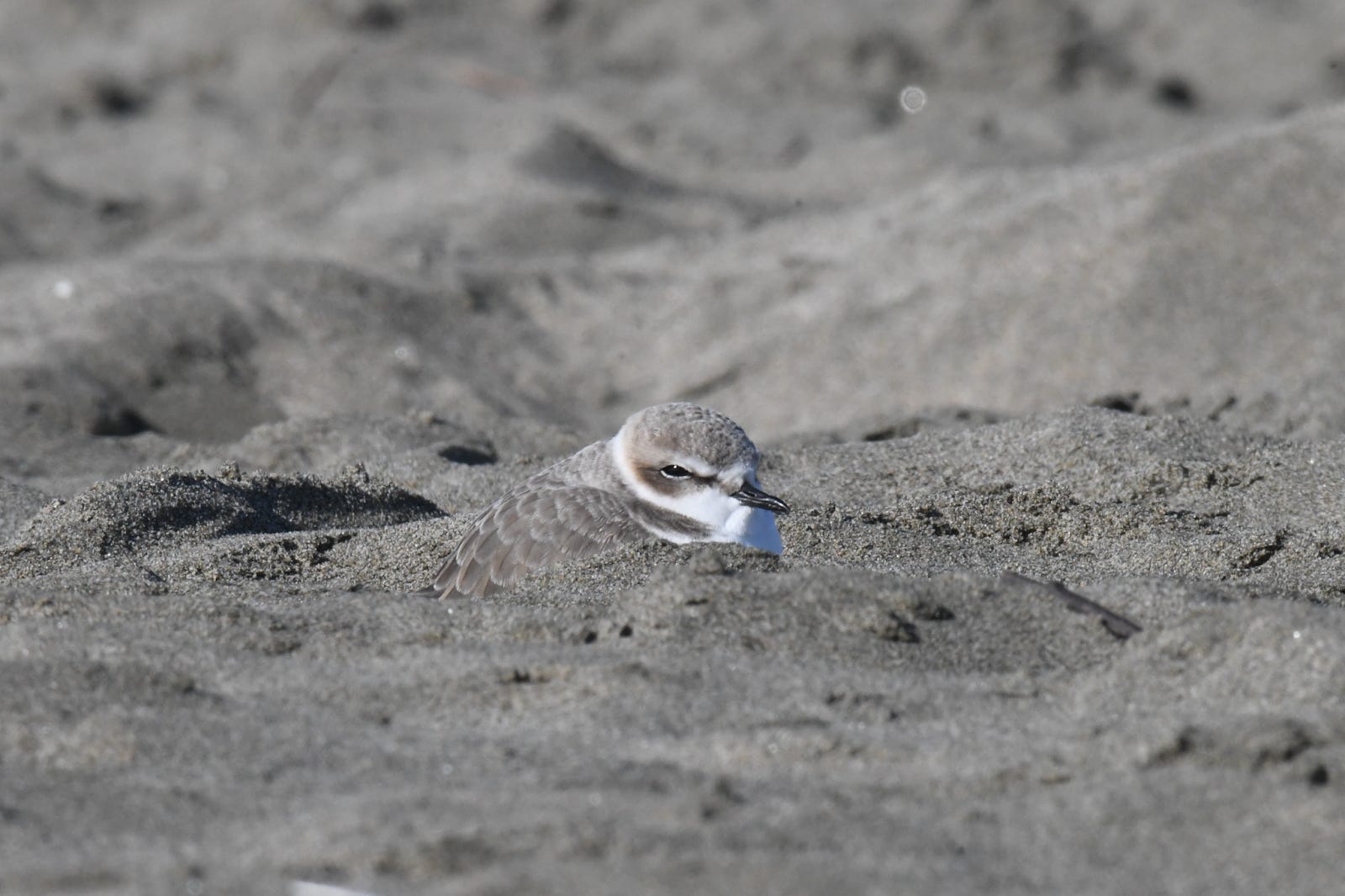
Napping in the human footprints, plovers often have a single eye watching you intently. An eye open to dogs, e-bikes, hawks, and climate change. The last line of defense, watching us, watching me. I am the intruder too.
Despite our evolutionary distance, it’s easy to care about a special albino alligator, a charismatic bodega cat, or of course, the family dog. But can we extend that love to a threatened species who faces the most imperiled future of any of us?
I love everything you write, Chris!
Fantastic essay, Chris!