
Clark's Final Migration
The story of a miraculous Piping Plover named Clark Kent who continues to be an inspiration for the work of NYC Plover Project

A sticky warm breeze breaks off the jetty towards the shore. As a wave crashes on the beach, it dissipates, disappearing into the wet gray sand. Late July black flies hiss about, and dead Spotted Lanternflies litter the edge of the wrack line.
Off the distant horizon to the east, the first beam of red sunlight breaks the blue seascape. Today, at five years old, well within the life expectancy of a Piping Plover, Clark Kent will set off on his final migration.
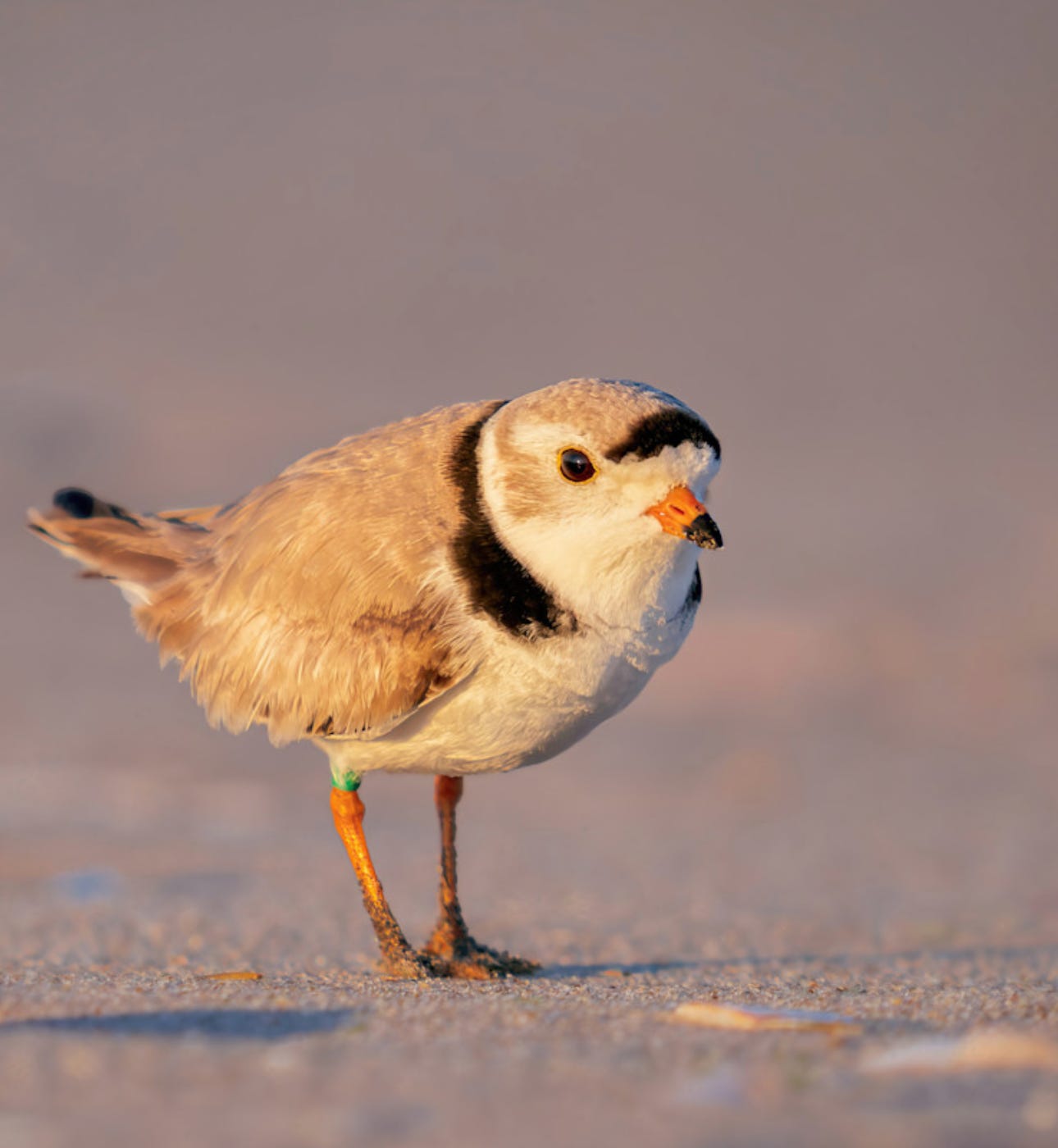
Born just five summers earlier on a barrier island off New Jersey, Clark quickly became Fort Tilden’s most famous Piping Plover. He sported colorful leg bands, donned upon him by the biologists who also gave him his name. With the swagger of a superhero, this tiny shorebird had spent every summer on our busy spit of sand since 2020.
Clark was the first Piping Plover I ever saw up close. It was the early days of the pandemic. People wore masks at the beach on a crisp April day. Off-leash dogs circled about, and kids trampled the dunes. I had heard of Piping Plovers of course, having spent every summer of my childhood on the Jersey Shore. There, intrepid plovers were akin to unicorns, where few saw them, and many more reviled them.
Island Beach State Park, a strip of sand dunes and scrubby pines, dotted by fishermen and beachgoers, is crammed between the busy beach town of Seaside Heights to the north, made famous by MTV’s Jersey Shore, and to the south, the tony northern end of Long Beach Island. Island Beach was not only a place known by scores of day trippers escaping the mainland heat, but also a significant breeding ground for the endangered Piping Plover.
Hundreds of miles to the south across the great waters of the Atlantic, lies Andros, a sparsely populated flat forested island in The Bahamas. A short distance from Nassau and glitzy resorts like Atlantis, lies Andros’ uninhabited Joulter Cays and sleepy coves and bone-white sandy beaches like Kamalame Cay and Staniard Creek. Here is where Clark spent his winters, surrounded by hundreds of other migratory Piping Plovers and resident Wilson’s Plovers. Long, sun-filled, drama-free days without the concern of predators or little ones to look after, Andros is a veritable Club Med for shorebirds. Arriving in August, Plovers and many other species remain until March before they head north again to breed.
The first time I saw Clark, I did not know his story. It was only after reporting his little pink, yellow, green and blue cuffs, did I learn that he too was a Jersey boy, born not far from me, on the beach where I spent all those carefree summers myself.
Summer 2023 was different. Clark had formed a bond with another banded Piping Plover. She was born on Fire Island, only one season before. Barely a year-old, call it beginner’s luck, she reared four chicks on the edge of the dune on the outer beaches of Rockaway in Queens.
There are massive hurdles that a Piping Plover has to tackle - to find a mate, build a nest, lay four eggs and then incubate those eggs, night and day for one month. They are surrounded by both curious and clueless onlookers of both the two- and four-legged varieties. Feral cats stalk their every movement. Crows circle above waiting to swoop down and crack open their eggs. And, feisty terrestrial ghost crabs run rampant across the sand. The occasional drone whirls above, with the only welcome avian visitor being an Osprey who is more interested in capturing fish from the sea to take them back to their young, in nests just up over the highest dunes to the west.
In 2022, Clark and his mate set up their nest at Post 1, at the edge of Jacob Riis Park, one of the busiest beaches in New York. This is literally the worst possible location for a sand-colored nest. A well-intentioned birder set up their scope which led to a little too much attention being drawn to the nesting pair. Early one morning, just before the July 4th holiday weekend, a mess of human footprints revealed that a person the night before had slid under the stringed fence and stole the eggs.
The next summer, Clark’s four chicks were all killed by predators, most likely cats, within 12 hours. I remember that day as if it were yesterday.
It was an unseasonably cool day in late June. The warm air rolling in from Brooklyn met the cool, salt spray of the Atlantic to form a deep fog. I sat about 20 feet from Clark. His female mate had left and he was alone. Just him and I, as if we were sitting shiva, mourning the loss of his fragile little ones who only knew this world for a few hours.
Clark’s sheer grit and tenacity quickly had so many of us captivated. He became the best possible ambassador for the NYC Plover Project and our work. He was not just another bird on the beach, but a bird with a story and unique characteristics, who traveled some 2,200 miles round trip each year to return back to New York City. Beachgoers learned Clark’s story and asked about him, artists drew his portrait and dozens of photographers yearned for a chance to snap his image.
His mate this year was fierce. She fought with the neighboring American Oystercatchers, a bird 10-times the Plovers’ size. Going out of her way to provoke them, she went after hawks, dogs, and people. Clark had met his match.
As what happens with Piping Plovers, four chicks can quickly become three, and then two, and then one, and then none. This year, three chicks survived the first week, with two making it to three weeks. Our volunteers watched over Clark, his brood, and his young partner, with unwavering dedication and enthusiasm. We had eyes on this special family from sunup to sundown. When two chicks became one, we knew we had to do everything possible to keep little “Clark Junior” alive. Several of us contemplated sleeping on the beach, as night watchmen.
And then the impossible happened, their little chick fledged. A fledgling chick is the ultimate goal of Piping Plover conservation - a chick that gets fat and strong fast enough, so that it can ultimately fly. Supposedly, this should be 26 days, but on busy beaches, research has shown that chicks can take much longer. We had one chick take 50 days before we first saw them fly. Busy beaches with heavy disturbance prevent the precocial little ones from feeding at the water’s edge. What’s different from many other birds is that Piping Plovers must feed themselves from birth, a trait they share with a small assortment of other species ranging from domestic chickens to geese and rails. Covered in a light layer of down, they bravely head where the surf crashes on the sand and thousands of walkers, surfers and dogs lurk as well.
The day we saw Clark’s little one first fly was indeed one of the best, if not the best day since the Plover Project started. We got to know Clark after spending hours with him. We were there when his nest was vandalized. I was with him hours after his last chicks were predated one summer prior. We were invested. And, seeing this chick was watching success in the flesh. His offspring! He continued! What’s more is that this little chick was only one of three survivors this summer, from the nearly twenty pairs who attempted to nest here.
We were able to share Clark’s story too to skeptics who mistakenly felt that these birds were plentiful and lacked familial units, or even intelligence or the tenacity to overcome life’s obstacles. What Clark taught even the most jaded new yorker is that this tiny being mattered just as much as they did.
Clark awoke as sunlight drenched the beach. Laughing Gulls’ cries pierced the din of the tide spilling back to the sea, after enveloping the cool black rocks of the jetty.
A jogging lifeguard shuffled through the sand, with wet nylon feverishly slapping his sunburnt skin. Clark’s little one was at the shore, amongst the sounds and activities of Fort TIlden just waking up.
Fierce mama had left two weeks prior, which is often the case when the females see that the males have things under control.
While I would have loved to witness Clark and his son or daughter set off together over the ocean, this was not Clark’s plan. Today, he set off alone. Unbeknownst to his little one, unbeknownst to me or to anyone.
No throngs of beachgoers buzzed below, the beach was still; no boomboxes, no laughter from children, no whirling drones or ebikes, just the quiet sound of the unusually low tide below.
Clark hurled forward, peep-lo, peep-lo, as if saying goodbye to Fort Tilden. I am not sure if Clark was seen during his migration, which likely took him mostly over water, but we never did see Clark again.
Did a Humpback Whale or a pod of Bottlenose Dolphins spot him from below, or perhaps a flock of Sanderlings or a few Cormorants sprinting along the caps of the waves. More likely, it was a solo flight, through the dark, first over the vast, submarine Hudson Canyon, and then just off the barrier beaches of New Jersey, undoubtedly past Island Beach where he was born, before heading down along the Delmarva Peninsula and up over Cape Hatteras. I often imagine this flight of Clark’s, perhaps during a sunset before disappearing from sight.
Piping Plovers are not sentimental. They have no time for remorse or regret. But it is hard not to think about the timing of Clark’s final migration, so perfectly in tune with the survival of his first and only known offspring.
It was as if Clark’s purpose was realized. He had accomplished what he was hardwired to do - survive and reproduce. For that, Clark was and is a success. He has grown the population, doing his part to combat his species’ eradication.
But I cannot help to think about what Clark has done for me, for us, for countless jaded New Yorkers who had come to love him.
He gave us hope, a story to celebrate, and someone meaningful to believe in - a superhero to marvel.
first published in Ink & Insights, anthology by Kathryn Aalto, May 2025
What a beautiful and moving tribute, Chris
Clark’s story truly captures the heart
Thank you for sharing his journey with such care and hope