
Bean
The disheveled lop-eared rabbit who led me to start an organization to protect an endangered species

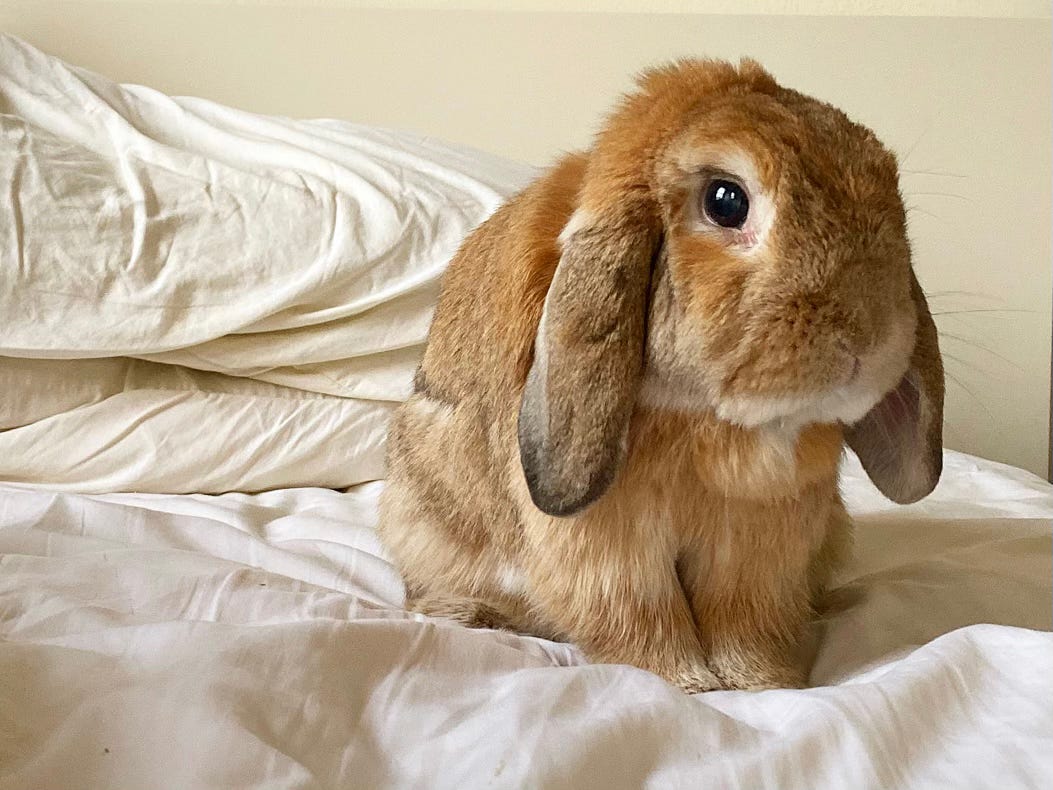
Five years ago today, I lost my best friend, a lop-eared rabbit named Bean who led me to start the NYC Plover Project.
I remember the morning like it was yesterday. “Bean did not make it,” our veterinarian said solemnly. He was admitted to their care the afternoon before. We had every reason to believe that he would be ok. Bean, the first rabbit and pet to come into my life as an adult, was a sensitive guy. He would often get bouts of stasis, when a rabbit’s guts stop moving. Bean usually pulled through with some TLC and meds. What brought him to his death that day is still a mystery, but surely it was far more serious.
We had tons of animals growing up. At any given time, there were chickens, a parade of rescued cats, a sheepdog, rabbits kept outside in a hutch, gerbils, hamsters, mice, and a Shetland pony. As a child, I was drawn to small critters. But for most of my adult life, I stopped thinking about them altogether. Animals – or their condition, place in the world, or suffering – never factored into the choices I made. I ate and wore what I wanted. It was as if animals didn’t even exist. For the majority of my years, I couldn’t tell you about one bird that I saw.
Fast forward to April 21, 2016, and I found myself walking through the doors of New York’s Animal Care Centers shelter in East Harlem. I was there to adopt a rabbit. Wait, what?
I know I am moving fast, but stay with me. I partly blame Instagram as my partner Sam and I would often send funny memes of rabbits to one another. I guess that is when and how it started.
There were thirty rabbits in the room that April day, behind steel bars, stacked on top of one another in individual cages. Some were sleeping, others chewing hay, or digging in boxes of newspaper clippings; they were white, gray, black, brown, golden, spotted, large, small and in between. It was overwhelming, so after a few minutes I decided to leave. A rabbit caught my eye behind the door, in the back of his cage. I approached and before I could get any closer, he immediately turned around and thrust himself against the inside of the bars with a thud. I jumped. A volunteer said to me that I could open the door if I wanted to. I cautiously put my hand into his lair, only for him to jump onto my arm, start humping it, and then bite me. I knew at that moment I needed to take this rabbit home.
This is when “Russell” and I first met. I later learned that Russell was found abandoned in a nearby city park, maybe Central Park, but left outside to fend for himself. He was in awful shape – scrawny, a dirty blanket of matted fur over a pile of bones.
That weekend, I couldn’t stop thinking about Russell. Sitting in that cage alone, behind the door, in the city shelter. On the following Monday, the 25th, he was to be having his neuter surgery. I still hadn’t committed. I had yet to tell Sam that we needed this rabbit.
The next morning, I woke with an intensity and purpose I hadn’t felt for some time: I was going to go to the shelter to bring Russell home. I was worried that someone else may have beat me to it and snatched the little malnourished, humpy lop rabbit. But thankfully, I was there in time.
That’s what happened, we adopted a rabbit. Russell became Bean. We fattened him up, his fur grew thick and shiny, and he was happy. The newly-purchased pen was quickly put away, and Bean had the entirety of our studio apartment. Sam fell in love with him as quickly as I did. I wanted to spend all of my time with Bean. He was home, a ballast of safety and comfort, which kept the chaotic din of the city far below. The perfect evening was spent laying on the floor with Bean at my side, while watching British crime dramas.
Bean brought me to the moment, not the months or the years, but the individual fleeting seconds and minutes that make up our days. He wanted nothing more than to be pet, for hours and hours. When my hand got tired, he’d nudge my arm just to make sure I wouldn’t stop. Bean helped me reconnect to animals in a way that I had never expected.
This little prey animal species, whose fellow rabbits are tested upon and raised for food, inspired me to become vegan. I have been ever since. All that follows, I attribute to him. I joined the board of directors for an organization that rescues cows, sheep, pigs, and other farmed animals, called Farm Sanctuary. Newly motivated to be an advocate for rabbits, I enlisted as a rabbit care volunteer at the Brooklyn location of the shelter where I adopted Bean, also to help make amends for those childhood Easter gifts left alone outside. I joined the board of the Wild Bird Fund, the only wildlife center in New York City, and I received my New York State wildlife rehab license so I could help with triage and transport of injured birds and mammals.
In April of 2020, week five of the global pandemic, I took a subway and a bus to get to Fort Tilden, a beach I had only been to a few times before during the summer months. There were dozens of New Yorkers, most with masks on, odd for a beach scene, all adequately social distancing. And there were dogs, so many dogs, more dogs than people.
I had picked up binoculars and a camera for the first time. I was not yet a full-on birder, but birds had begun to take hold of me. A couple months prior I saw a canary-yellow female Painted Bunting in the park near our apartment, which prompted me to research how she had gotten so far off course. I never did find out, but I read that three billion birds have died since 1970 due to humans, that every single species of shorebird was in decline, and that birds were fatally colliding with glass-paneled skyscrapers by the millions. All the while, earnest birdwatchers, myself included, rushed with fevered urgency to chase vagrant migrants like the bunting, ticking them off in eBird, and then going on about our business.
Back to Fort Tilden, birds weren’t on my mind that day. I simply needed to get outside. I didn’t wear a mask. I had no problem keeping my distance from people. Families flew kites of all sizes, as a large drone whirled over a single man dressed in head-to-toe camouflage. Kids scaled the eroding faces of sand dunes and jumped off some fifteen feet below, causing clumps of grass and plants to collapse and sand to pour forward like Niagara. Their parents ignored them from blankets down the beach with chilled wine in glass goblets. And then I heard it amongst the sounds of all the voices, the barking dogs and the screams of the children.
Peep-lo, peep-lo.
I first heard the faint melodic call from the edge of the water. I lifted my binoculars to my eyes but I could not see anything. And then I heard it again. I heard the siren-like call behind me, towards where the children were crisscrossing the dunes.
I peered through the binoculars again, and this time I spotted him. A bright orange beak and matching legs, with a stunning, ink-black collar. Big beautiful eyes were framed by a charcoal brow-line.
The Piping Plover.
I recalled the name of the species from the New Jersey beaches of my childhood, but the dogs and the children, and the lack of signs or fences, stuck with me. Something was wrong with this scene: a tiny endangered bird trying to survive in a chaotic environment which was thwarting that very impulse.
Why wasn’t everyone marveling at these birds? Why were there so many dogs? And where were the park rangers?
I kept birding that spring, documenting the species I had been seeing. Despite the terrible headlines, seeing birds was a lift. There were 164,000 Covid cases and 13,000 deaths in New York City by the end of April 2020. Masks weren’t yet widely available, neither was hand sanitizer, but I wore two bandanas and plastic gloves and I took Citibikes to Prospect Park, and walked down the hill to Brooklyn Bridge Park in my neighborhood. A friend said that I was the only person she knew that was thriving through the pandemic. “It’s the birds,” I said without missing a beat.
One thousand, six hundred eighty-three days after we adopted Bean, the unthinkable happened. Bean had died.
The next day, we drove to the vet to see him one last time before he was to be cremated. He was delivered to us on a fleece blanket by two vet techs. He was on his side, as if resting peacefully. We brought his partner Sydney along so she could say goodbye. We set her on the cold tile floor. She ran over and sniffed him, then groomed his head and sat next to his lifeless body, not understanding any more than we did. My face and the collar of my sweatshirt was wet with tears. We left the room, with Bean still there.
I thought of previous versions of myself who would have judged someone for being so devastated about a dead rabbit. What is wrong with him? No one said that to me, but I thought it. They must be thinking, he’s lost his mind … over a rabbit. Remnants of a person within me were shedding with the death of Bean.
Another spring migration soon followed, and I woke up one morning, March 21, 2021, and decided to go look for the plovers back at the beach in Queens. There, a Piping Plover awaited me, seemingly as if I had never left. But the bird likely had flown 2,000 miles round trip on a fall and spring migration since April 2020. While I was thrilled to see this old friend, I was immediately horrified by what I saw unfold, an off-leash dog inches from capturing a plover in its mouth, while its owners stood by laughing.
I ran towards them. “What are you doing!” I was met with bewildered faces. “Your dog is about to kill that bird, which just arrived on a long migration, not to mention is also federally-protected under the Endangered Species Act.”
“Calm down, dude,” said the mother in front of her children.
But, I was calm. If they wanted to witness not calm, they should have met my father Carl. He would’ve met this situation with unsettling directness, a sharp tongue and raised voice. I thought I had handled that situation well, but maybe I did not. I wanted to go back and apologize. But that would be shortchanging the birds. And my father would’ve been furious with me.
As they called their dog, leashed it and left the beach, it struck me. There was zero awareness for this bird, or little that I could see. I needed to do something about this and it needed to be done now.
On the long subway ride from Queens back to Brooklyn, I stopped being a birder. I knew that this species was in danger and I needed to stop focusing on the life list of birds who I spotted, which was rapidly accumulating. My list then became a list of one, and that was the Piping Plover. Three days later, I posted one image to a newly-created Instagram account, the NYC Plover Project. I decided to call it a project, because then it would be temporary, and it wouldn’t take over my life. Right, it won’t take over my life.
More than four and a half years have passed since I founded the NYC Plover Project. We have a staff of five and more than 350 volunteers have performed more than 18,000 hours of volunteer work in our first five seasons on the outermost beaches of New York City. We were named volunteer group of the year in the nation by the National Park Service. We are in NYC public schools, forging relationships with diverse community groups and trying to do everything we can to build a groundswell of support for the plovers in a city of millions of busy New Yorkers.
I will never get to know the plovers as I did Bean. They are out on their own all of the time, with an onslaught of forces working against them. Unbeknownst to them, however, they also have an army of concerned New Yorkers working on their behalf, led by me. Just as I don’t understand why Bean took hold of me, I don’t fully yet comprehend my connection to the plovers.
People have said, it is great you are helping the voiceless. But plovers do have voices, beautiful melodic calls that you may hear if you are lucky enough. If anyone was voiceless, it was me, prior to 2016. A small bedraggled rabbit and a tiny endangered bird helped me find my voice.
This was beautiful and inspiring!
So much heart goes into this project! It’s a joy to see it grow and to be part of…thank you for creating this important community that protects such a precious species!! 💛🐥💛